
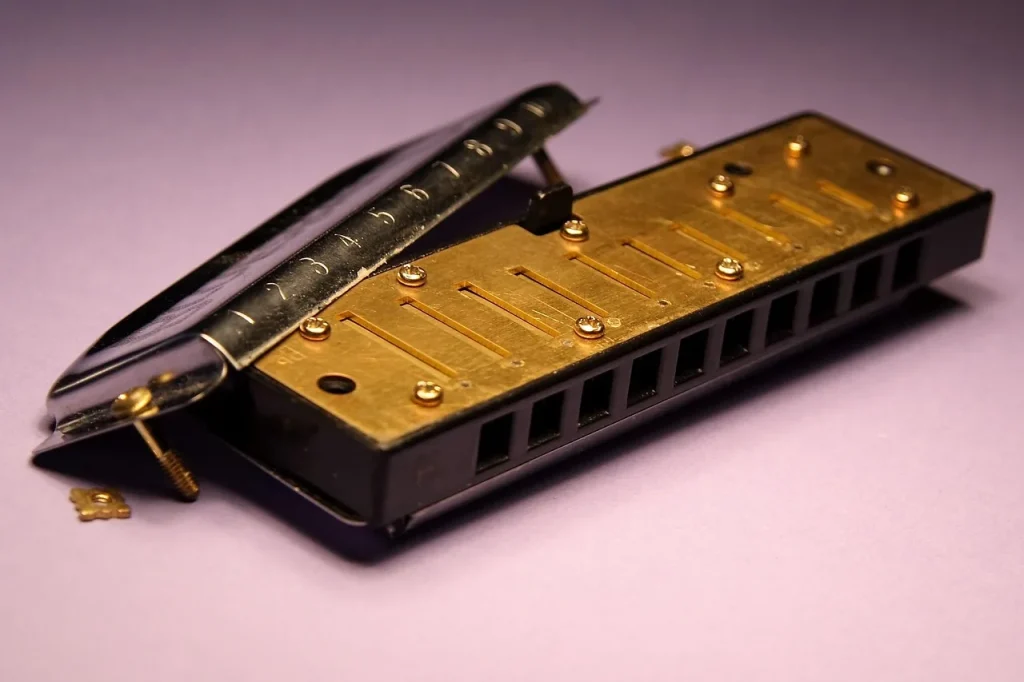
A musical instrument deserves care suited to its delicate mechanics. Models fitted with a movable slide require special attention to preserve their sound quality.
Unlike diatonic versions, these harmonicas have plates and reeds that are more sensitive to dust buildup. Regular use naturally causes deposits that affect note accuracy.
A suitable cleaning routine prevents metal parts from oxidizing. Specialized tools such as the C.A. Seydel Söhne kit make it easier to maintain complex mechanisms without risking damage to the components.
Applying silicone oil to moving parts considerably extends the life of the instrument. This simple practice keeps the slide moving smoothly and preserves the characteristic resonance of the reeds.
Why cleaning your chromatic harmonica is essential
Regular maintenance preserves sound quality and prevents costly breakdowns. Components such as reeds and plates wear out quickly without proper care.
The risks of a poorly maintained instrument
Saliva and food residue accumulate in the channels. This blocks the reeds and reduces note accuracy.
The metal plates may oxidize. The slide springs can also corrode, making playing less smooth.
According to one study, 43% of breakdowns are linked to poor maintenance. A wooden comb warped by moisture is expensive to replace.
The benefits of regular cleaning
Protecting your instrument helps maintain its characteristic tone. Note accuracy remains optimal, even after years of use.
Avoiding repairs saves money. For example, replacing a reed at Hohner costs around €35.
| Aspect | Risks without maintenance | Benefits with maintenance |
|---|---|---|
| Sound quality | Altered notes, dull tone | Clear, precise sound |
| Costs | Frequent repairs | Long-term savings |
| Playing | Stiff slide, discomfort | Smoothness and comfort |
Preparing your harmonica before cleaning
The preparation stage determines how successful the maintenance will be. A suitable method protects fragile parts and simplifies the following steps.

Warming the instrument to prevent damage
Place the instrument in your pocket for 10 to 15 minutes before playing. This stabilizes the temperature and reduces the risk of condensation.
Avoid direct heat sources. Gradual warming protects the reed plates and springs.
Carefully removing the plates and reeds
Use a Phillips screwdriver, such as a Wiha model, to remove the screws. Mark each plate with a felt-tip pen to ensure accurate reassembly.
Place the parts in a compartmentalized case. Non-magnetic tweezers help with handling delicate springs.
| Model | Spring type | Recommended tools |
|---|---|---|
| Hohner CX-12 | Steel springs | Fine tweezers + 1.5 mm screwdriver |
| Suzuki SCX-48 | Brass springs | Magnetic screwdriver |
The reed plates must be separated carefully. Monitor the ambient temperature to prevent thermal shock.
Key steps for thorough cleaning
Discover the techniques for safe, meticulous cleaning. Each component requires special attention to prevent premature wear.
Cleaning the plates and holes with cotton swabs
The holes and plates accumulate dirt and residue. Use lightly moistened cotton swabs to remove deposits.
Pay particular attention to the areas around the reeds. Avoid sudden movements that could bend the reeds.
Using a water and vinegar solution for metal parts
Mix 1/3 white vinegar with 2/3 demineralized water. Soak the metal parts for no more than 20 minutes.
- Rinse with clean water after soaking.
- Brush the holes with a synthetic brush.
Avoiding excess moisture on wooden combs
Wooden combs warp when exposed to moisture. Dry them immediately with a microfiber cloth.
For models made from ABS plastic, 70% isopropyl alcohol is an effective alternative.
| Model | Recommended method | Precautions |
|---|---|---|
| Hohner Super 64 | Vinegar solution for the plates | Avoid moistening the wooden combs |
| Seydel Symphony | Isopropyl alcohol for ABS combs | Monitor the soaking time |
Maintaining the chromatic harmonica slide
The slide is crucial to the instrument’s proper operation. Its complex mechanism requires special attention to prevent sticking and ensure a long service life.

The importance of silicone-based lubrication
Regular lubrication keeps the slide moving smoothly. Silicone-based products, such as Slide-O-Mix, are specially designed for metal slides.
Partial disassembly is often necessary to reach critical areas. Use a lint-free cloth to remove residue before applying any lubricant.
- Ideal frequency: every 50 hours of playing.
- Technique: apply to the rails with a fine brush.
- Avoid: thick greases that attract dust.
How to apply oil without overloading the mechanism
Too much oil can impair the mechanism. Two drops are enough to cover the friction surfaces.
Spread the product evenly with a cotton swab. Wipe away any excess to prevent buildup.
| Lubricant type | Advantages | Disadvantages |
|---|---|---|
| Silicone oil | Non-sticky, compatible with alloys | Requires frequent applications |
| Teflon grease | Long-lasting action |
Careful maintenance of the slide ensures precise, comfortable playing. Adjust the lubrication frequency to how often you use the instrument.
Common cleaning mistakes to avoid
Some habits can damage your instrument without you realizing it. Choosing the wrong products or neglecting drying considerably shortens its service life.

Products you should never use
Powerful solvents such as acetone or mineral spirits attack metals and seals. Even isopropyl alcohol, which is often recommended, should be used sparingly.
“Whisky, with its acidity and sugary residue, is one of the worst homemade cleaners for reeds.”
- Blacklist: bleach (corrosion), ammonia (discoloration).
- Risks: seals harden and crack.
The importance of meticulous drying
Residual moisture causes rust and mold. Use pH paper to check that no acidic traces remain after rinsing.
| Mistake | Consequence |
|---|---|
| Failing to grease the screws | Oxidation and mechanism blockage |
| Drying in the sun | Warping of wooden combs |
One documented case shows that the pearwood comb of a Hohner 280 was warped by prolonged exposure to moisture. Use a microfiber cloth and a well-ventilated location.
Conclusion
Taking care of your instrument ensures years of optimal playing. Thorough quarterly maintenance preserves its longevity and performance.
Compared with frequent replacement, this routine saves time and money. Store the instrument in an environment with a relative humidity of 40 to 60% to prevent moisture damage.
For high-end models, an inspection by a professional is recommended. This additional investment protects sensitive mechanisms.