
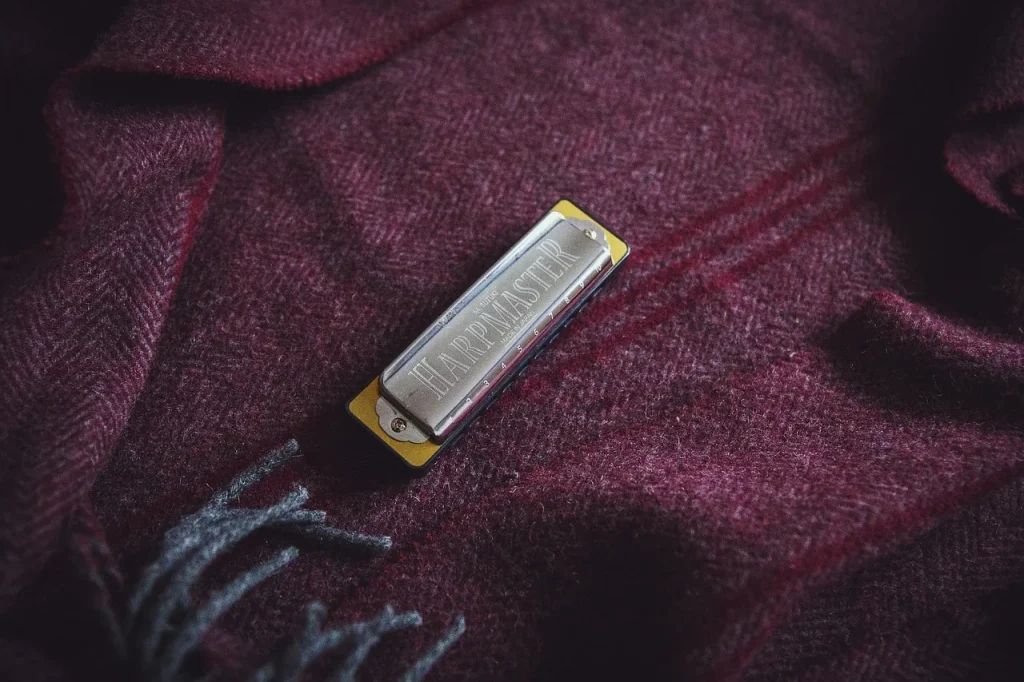
Learning to play an instrument such as the harmonica can seem complicated without any knowledge of music theory. This guide makes learning easier through tablature, an intuitive method for beginners.
The diatonic harmonica, popular in blues and rock, is ideal for expressive playing. Its bends and portability make it a favorite among musicians.
Did you know that this instrument is one of the best-selling in the world? From American pioneers to French blues musicians, it has endured through the ages. To take things further, resources such as videos and backing tracks are available.
Introduction to harmonica tablature
You do not need music theory to get started. Tablature offers a clear alternative to traditional sheet music, making it ideal for self-taught players.
As with guitar, it indicates the notes to play. Here, however, the symbols “+” and “-” replace strings, making it even easier to read.
The 10-hole diatonic harmonica has its own particular features. Holes 4 to 6 require mastery of bends, a key blues technique.
For example, “+4 -4 +5” means: blow into hole 4, draw through the same hole, then blow into hole 5. Simple, right?
Did you know that 80% of beginners choose a diatonic harmonica? Its gradual learning curve is appealing, as shown in the book Harmonica For Dummies.
Take “Oh Susanna”: “-2 -3 -2 -3 -4 -4”. After just a few attempts, the melody comes to life. Give it a try!
The basics of harmonica tablature
Mastering the notes on this instrument starts with understanding its simplified language. Tablature turns music into clear instructions that are accessible even without music theory.

The hole numbering system
A diatonic harmonica has 10 holes, numbered from 1 to 10. Each hole produces two distinct notes: one when blowing and another when drawing.
“Standardized numbering makes it possible to play any song without knowing its original sheet music.”
Blowing or drawing: understanding the + and – symbols
The “+” sign indicates a blow note, while “-” indicates a draw note. For example:
| Hole | Blow (+) | Draw (-) |
|---|---|---|
| 4 | C | D |
| 5 | E | F |
| 6 | G | A |
A useful mnemonic is: “Blow (+) = pure sound; draw (-) = blues soul”. This distinction is crucial to the characteristic keys.
The importance of the harmonica’s key
Choosing between a harmonica in C or A directly affects the notes available. C is ideal for beginners, while A offers warmer tones that are perfect for blues.
To explore these concepts in greater depth, the book Harmonica For Dummies offers progressive exercises.
Apply this method to a classic such as Sweet Home Chicago: “-2 -3” -2 -3 -4 -4″. The apostrophes indicate bends, an advanced technique that takes time to develop.
How to read harmonica tablature
Tablature turns music into clear instructions. Unlike traditional sheet music, it uses simple symbols to indicate the notes to play. Let us see how to decode it effectively.
Decoding basic notation
Standard tablature shows three main elements:
- The hole number (from 1 to 10)
- The direction of airflow (+ or -)
- The duration of the notes (quarter notes, eighth notes)
For example, “-3 -4 +5” reads as follows: draw through hole 3, draw through hole 4, then blow into hole 5. This simple melody often forms the basis of blues songs.
Bend notation (-3′, -3″)
Bends add expressiveness. They are written with apostrophes:
| Notation | Effect | Technique |
|---|---|---|
| -3′ | Half-step bend | Light lip pressure |
| -3″ | Whole-step bend | Diaphragm control |
A progressive exercise: start with simple quarter notes, then add bends. Use a metronome at 60 BPM to keep the rhythm.
How to interpret rhythm
Tablature does not always indicate the duration of the notes. Pay attention to the musical phrase:
“Syncopated ‘chabada’ eighth notes give blues its distinctive character. Listen to songs such as Sweet Home Chicago to recognize them.”
Practice this typical blues lick: “-2 -3” -2 -3 -4 -4″. The apostrophes indicate bends, while the spaces suggest rhythmic rests.
Special techniques and their notation
Professional blues players use precise techniques to produce unique sounds. These methods, represented in tablature, add soul to every musical phrase.
Bends and overbends
Bending a note (a bend) is essential in blues. Apostrophes are used in the notation: “-4′” for a half step and “-4\”” for a whole step.
Overbends are more complex and require control of the pharynx. Try imitating a train whistle to feel the pitch change.
Effects: vibrato, tremolo, and wah-wah
Vibrato is created by making the airflow oscillate in the throat. For a warm effect, keep your tongue low.
The “wah-wah” is produced by opening and closing your hands around the harmonica. Try it on the Beatles’ Love Me Do!
Articulations (OU, T, KA)
These symbols shape the rhythm of your playing:
- OU: tied note
- T: tongue stroke
- KA: accent
Watch out for “dirty notes”: technically out of tune but expressive, and typical of roots blues.
“A puckered embouchure limits bends, unlike the relaxed approach used by blues players.”
Understanding harmonica tablature: a practical guide
Moving from theory to practice becomes easy with concrete examples. Let us analyze a typical blues lick together to put the essential concepts into practice.

Breaking down a blues lick in C
Take this sequence: “+4 -4′ +5 -5 +6”. Here is how to understand it:
- Blow into hole 4 (C note)
- Draw with a half-step bend (D-flat)
- Continue with E and F while controlling the airflow
This five-note pattern forms the basis of many traditional songs. Practice it slowly before speeding up.
Three-stage practice method
To make effective progress:
- Decoding: read the tablature without playing
- Rhythm: add the tempo with a metronome
- Expression: incorporate dynamics and effects
Spend 15 minutes a day on each stage. As this beginner’s guide suggests, consistency matters more than the length of each session.
Common pitfalls and solutions
Seventy percent of learners give up when faced with bends. Here is how to avoid the pitfalls:
| Mistake | Solution |
|---|---|
| Neglecting tuning | Check intonation every week |
| Forcing the breath | Work on diaphragm control |
| Skipping the warm-up | Play simple notes for 5 minutes at the start of each session |
“A good bend is like a musical sigh. Imagine blowing on a spoonful of hot soup.”
To go further, create a 30-day program with specific goals. Alternate technical exercises with motivating songs.
Progressive practice exercises
Improving on the harmonica requires structured exercises. Here is a series of techniques for effective practice, from mastering basic notes to playing complex musical phrases.

Exercise 1: single notes
Begin with an essential lip warm-up:
- Play ascending and descending scales (+4 +5 +6 -6 -5 -4)
- Hold each note for 4 seconds while controlling your breath
- Focus on G (blow hole 6), which is often used in blues
“A 5-minute warm-up prevents 80% of wrong notes. Draw inspiration from the exercises in Beginner Harmonica.”
Exercise 2: adding bends
Move lower on the instrument (holes 1 to 3) to practice bends:
- Play “-3” normally, then try “-3′” by lowering your jaw
- Alternate continuous airflow and bends using the pattern “-2 -2′ -3 -3′”
- Try this technique on Heart of Gold by Neil Young: “-4 -4′ -5 +6”
Exercise 3: a complete musical phrase
Apply this method to a G7/C7/D7 blues progression:
| Chord | Tablature | Duration |
|---|---|---|
| G7 | -2 -3” -2 -3 | 4 beats |
| C7 | +4 -4′ +5 | 2 beats |
| D7 | -3 -4 +4 | 2 beats |
Gradually increase the tempo from 50 to 120 BPM over 4 weeks. Record yourself to analyze your progress!
Going further with tablature
Unlock new musical possibilities with these advanced tips. Whether you want to play songs in different keys or decode complex notation, these techniques will enrich your practice.

How to transpose for other harmonicas
Want to change key without relearning every tablature? Use this quick conversion table:
| Original key (C) | Transposition to A | Transposition to G |
|---|---|---|
| +4 (C) | +2 (A) | +3 (G) |
| -4 (D) | -2 (E) | -3 (F-sharp) |
Tip: the HarmoTab app automatically converts harmonica tablature between 12 keys.
Reading complex tablature
Some symbols require special study:
- Arrows (↑↓): glissando between notes
- Parentheses: muted notes
- X: tongue percussion
“EastTop and Hohner Special 20 harmonicas provide ideal intonation for these techniques.”
Resources for finding tablature
Explore these references to play a variety of songs:
- Harp-L: more than 200 free blues tabs
- Harmonica Academy: lessons with interactive sheet music
- Create your own tablature with the TablEdit method
When playing from these resources, start at slow tempos before adding expression.
Conclusion
Blues comes alive when the notes flow naturally. With a little practice, bends will become a pleasure rather than an obstacle.
Remember these essentials:
– Master single notes before moving on to advanced techniques.
– Join forums such as Harp-L to talk with other enthusiasts.
– Use free resources (tablature and videos) to improve.
“A good musician plays from the heart, not just with the lips.” — Little Walter
Always keep a harmonica with you. The pleasure of playing can strike at any moment!
Ready to learn to play like the greats? Start today, and the music will follow.