

Playing music is a rewarding experience, and some instruments are particularly well suited to self-teaching. Compact and accessible, this musical tool offers rare creative freedom.
Its greatest advantage? Unmatched portability. Slipped into a pocket, it goes everywhere with you, turning every free moment into an opportunity to improve. Many musicians say they have found it to be a spontaneous means of expression.
Three key elements make all the difference: immediate enjoyment, a suitable approach, and regular practice time. Our complete guide explains these aspects to support you.
Whether you are a beginner or simply curious, this musical adventure starts with solid foundations. Follow the path laid out here to explore the full potential of this art.
Why choose the harmonica as an instrument?
Among instruments, one stands out for its simplicity and expressiveness. Compact and affordable, it appeals to beginners and accomplished musicians alike.
A portable and spontaneous instrument
Slipped into a pocket, it can go anywhere. Unlike a guitar or piano, it weighs next to nothing. It is ideal for unexpected musical moments.
Models such as the Hohner Marine Band deliver a rich sound without being bulky. They are perfect for travel or coffee breaks.
Magical sounds without tuning
There is no string tension to check. All you need is your breath and your mind to create melodies. The notes are always in tune, even for a beginner.
Other instruments often require meticulous upkeep. Here, maintenance is limited to occasional cleaning.
The harmonica, a companion for every occasion
Public transport, evenings with friends, or solitary creative sessions: it adapts to them all. Its affordable price, starting at €30, lets you try it without taking a major risk.
Emotions emerge instantly. A single note can evoke the blues, joy, or nostalgia. Try it and you will never want to be without it.
What you need to start teaching yourself harmonica
Among the ways to begin making music, this instrument stands out for its accessibility. Before you get started, however, a few key elements will help ensure smooth progress.

How much time to devote to it
How long does it take to see results? A daily routine of 15 to 30 minutes is enough. Consistency matters more than duration.
Set aside a regular time, in the morning or evening, for example. This strengthens your commitment and keeps you from forgetting.
The ideal practice space
Choose a quiet place without an echo. A corner of the living room or a bedroom will work perfectly.
Avoid noisy places. The sound must be clear so that you can correct wrong notes.
The ideal beginner’s mindset
Choose a playful approach rather than one focused on performance. Enjoyment is the key.
Record your progress in a notebook. It will motivate you and show you how far you have come.
How long does it take to master the basics? About three months with diligent practice.
Choosing your first harmonica: a complete guide
Before producing your first notes, you must make a crucial choice: selecting the right tool. A suitable model speeds up progress and prevents frustration. Here is how to make the right choice.
Diatonic or chromatic: which should you choose?
The diatonic harmonica, often in C, is ideal for blues and rock. Easy to approach, it suits 70% of beginners. Its 10 holes offer a limited but expressive range.
The more expensive chromatic harmonica, starting at €100, is intended for jazz or classical music. Its slide allows you to play every note, but its complexity often discourages beginners.
The six best models for beginners
Among reliable brands, Hohner leads the field with its legendary Marine Band, launched in 1896, and the Special 20. Here is a comparison:
| Model | Type | Average price | Advantages |
|---|---|---|---|
| Hohner Marine Band | Diatonic | €50 | Brass reeds, warm sound |
| Suzuki Harpmaster | Diatonic | €35 | Airtight, durable comb |
| Seydel Blues Session | Diatonic | €45 | Precise tuning, ideal for blues |
How to avoid low-quality harmonicas
Be wary of brands such as Huang or Swan. Their attractive prices can conceal fragile reeds and imprecise tuning.
Choose authorized dealers. On Amazon, check the reviews and the seller’s authenticity. A cracked comb or muffled notes may reveal a counterfeit.
Essential basic techniques
To play comfortably, mastering the basic movements is essential. A proper grip and controlled breathing transform simple notes into expressive melodies.
Holding your harmonica correctly
Place the instrument between your thumb and index finger, forming a U with your left hand. This position stabilizes it while allowing the air to circulate freely.
Avoid gripping it too tightly. Light pressure is enough to prevent sound leakage.
Hand position and breathing
Use diaphragmatic breathing: inhale through your nose while expanding your abdomen, then exhale through your mouth. This improves control and endurance.
Gently cup the harmonica with your hands to vary the volume. Experiment with opening and closing your palms to create echo effects.
Embouchure: the Pucker or Tongue Blocking method
Two approaches predominate:
- Pucker, or pursed lips: ideal for beginners, this method lets you isolate holes with your lips.
- Tongue Blocking: the tongue covers several holes to produce chords or individual notes.
| Method | Advantages | Disadvantages |
|---|---|---|
| Pucker | Simple, well suited to melodies | Limits advanced effects |
| Tongue Blocking | Versatile, allows bends | Longer learning curve |
Practice in front of a mirror to correct jaw tension or air leaks. Consistency matters more than duration.
Mastering fundamental notes and positions
Learning the notes and positions is the key to playing fluidly. Once you have absorbed these basics, access to more complex pieces becomes natural.

Understanding the numbering system
The holes are numbered 1 through 10, from lowest to highest. The fourth hole produces a C when blown and a D when drawn. Apps such as Harp Trainer help you memorize these associations.
The three main positions to know
Each position corresponds to a musical style:
- Straight Harp, or first position: ideal for major-key melodies.
- Cross Harp, or second position: perfect for blues and rock.
- Dorian, or third position: used in jazz or improvisation.
| Position | Key or mode | Use case |
|---|---|---|
| Straight Harp | Major | Folk songs, easy access |
| Cross Harp | Blues | Expressive solos |
| Dorian | Minor mode | Jazz improvisation |
Exercises for memorizing notes
Start with the C major scale. Play each note by blowing and drawing, then repeat three times. Use mnemonic devices such as “1-blow-C.”
Practice with simple tablature featuring directional arrows: ↑ for blow and ↓ for draw.
Learning harmonica on your own: effective methods
The freedom to learn at your own pace opens the door to several methods. Each addresses specific needs, depending on your learning style and goals.
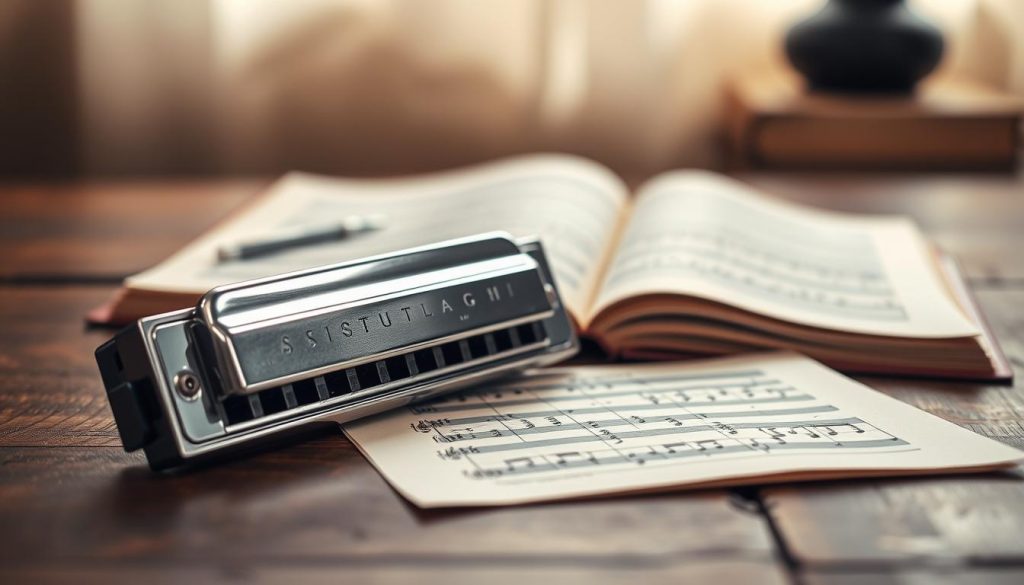
Online communities: sharing and mutual support
Forums such as Harmonica Academy provide a valuable space for discussion. Ask questions, share your recordings, and receive constructive feedback.
Facebook groups and Reddit communities bring together thousands of enthusiasts. They are ideal places to discover tips or free tablature.
Remote lessons: flexibility and guidance
Specialist platforms such as iMusic School and Superprof offer suitable lessons. Compare prices and formats:
| Option | Average price | Advantages |
|---|---|---|
| Private lessons | €20 to €50/hour | Maximum personalization |
| Subscriptions | €10 to €30/month | Access to video libraries |
A customized program: the key to consistency
Create a balanced schedule using the 50/30/20 method:
- 50% technique, particularly scales and breathing
- 30% repertoire, using simple pieces
- 20% improvisation, including backing tracks
Film your sessions to identify your progress. Consult this seven-step guide to structure your practice.
Advanced techniques: bending and effects
The instrument’s expressiveness is fully revealed through subtle pitch changes. These techniques turn simple notes into vibrant melodies typical of blues or rock.
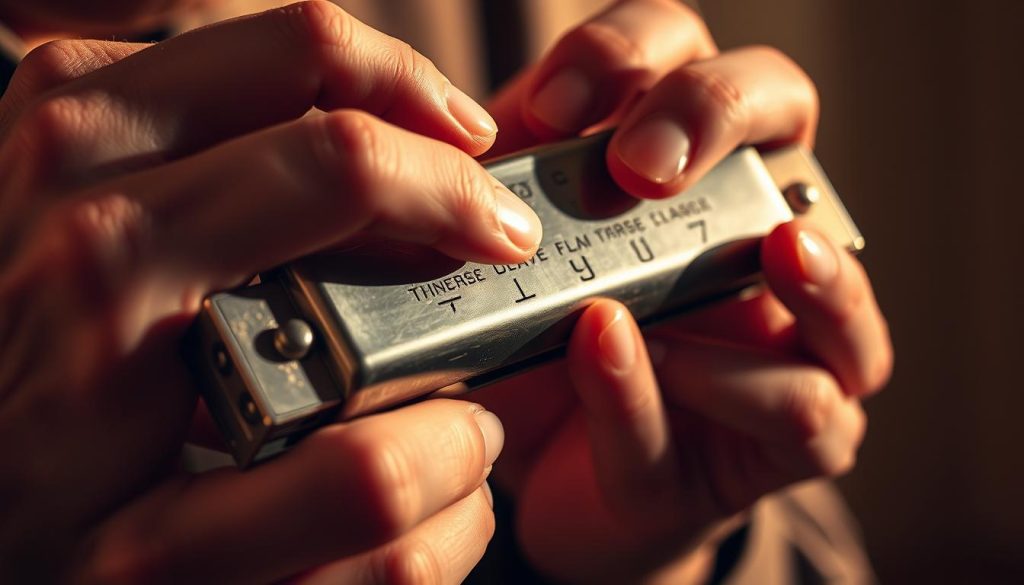
The principle of bending notes
Bending changes a note’s pitch by adjusting air pressure and tongue position. On holes 1 through 6, it is performed by drawing, and on holes 7 through 10, by blowing.
A relaxed jaw and a slightly retracted tongue are essential. Excessive pressure creates muffled sounds.
Progressive exercises for mastering bends
Start with the siren exercise:
- Play a clear draw note.
- Gradually lower your tongue to bend the sound.
- Slowly return to the original note.
Use a metronome set to 60 BPM to synchronize the movements. Gradually increase the speed.
Special effects to know
Three effects enrich your playing:
| Effect | Technique | Use |
|---|---|---|
| Tongue Slap | Briefly block the holes with your tongue | Percussive rhythms |
| Hand vibrato | Move your palms back and forth around the instrument | Sustained notes |
| Wah-wah | Quickly open and close your hands | Dynamic effects |
Practice each effect separately before combining them. Video tutorials will help you visualize the movements.
Reading and interpreting tablature
Deciphering tablature opens the door to many pieces. This simplified system replaces traditional sheet music with intuitive symbols and allows you to get started quickly.
Decoding the essential symbols
The arrows ↑ and ↓ indicate whether to blow or draw. A “b” denotes a bend, while parentheses indicate tied notes. Example: 4↓(b) means drawing through hole 4 with a bend.
Two notation systems coexist:
- International system: numbers and arrows.
- Alternative variants: + and – signs or blues notation.
Where can you find free tablature?
Several specialist sites offer resources:
- Harmonica.com, with a comprehensive database.
- 8notes, with tablature organized by musical style.
Tip: download PDFs containing chord charts for improvisation.
Moving from tablature to improvisation
Once you have mastered the structure, add embellishments:
- Hand vibrato for expressive notes.
- Slides between holes, without forcing them.
Use your imagination to create variations. Repeat a simple pattern while changing the rhythm or intensity.
Organizing your daily practice
Making rapid progress requires a structured approach. A well-designed schedule maximizes results while preserving motivation. Daily commitment, however brief, makes all the difference.
The ideal beginner’s routine
Divide your time into three key blocks:
- 5 minutes of warm-up: breathing exercises and simple notes.
- 15 minutes of technique: scales, bends, or new patterns.
- 10 minutes of repertoire: familiar pieces for enjoyment.
This balanced breakdown prevents boredom. Alternate styles to keep things varied and enjoyable.
Thirty minutes a day: a sample program
Here is an example of a themed week:
| Day | Goal | Tools |
|---|---|---|
| Monday | Bending | Blues backing track |
| Tuesday | Rhythm | Metronome |
| Wednesday | Improvisation | Pentatonic scales |
Use the Pomodoro method, with 25 minutes of playing and a 5-minute break, to stay focused.
Practicing effectively without a teacher
Record yourself every day to track your development. Compare monthly versions to measure your progress.
Set SMART goals:
- Specific, such as mastering the bend on hole 4.
- Measurable, using audio recordings.
- Achievable, with gradual steps.
A practice journal can be useful for recording difficulties and successes.
Solving common problems
Progress involves overcoming technical and mental difficulties. Whether the issue is poor posture or declining motivation, proven methods can help you work around it.
Correcting bad habits
Poor hand position or irregular breathing can slow down learning. According to studies, correcting an improper movement takes 21 days on average.
Film yourself regularly to identify errors. In some cases, a mirror is enough to correct your posture effortlessly.
Managing discouragement
Plateauing is a common reason for giving up. Set micro-goals, such as mastering three notes per week.
The method of accumulating small successes builds confidence. Even modest daily progress goes a long way over several months.
Making progress when you reach a plateau
FOG analysis—Frequency, Origin, and Gravity—helps you prioritize problems. At times, a mentor can identify obstacles that you cannot see.
| Problem | Solution | Duration |
|---|---|---|
| Imprecise bends | Siren exercises | 2 weeks |
| Unsteady rhythm | Metronome at 60 BPM or faster | 10 days |
In some complex cases, a one-off lesson with a professional can quickly resolve the situation.
Conclusion: your journey toward mastery
Every musician has a unique journey, and yours deserves to be celebrated. In a few months, you will master essential techniques, from bends to complex rhythms. Like Jean, who started six months ago, you will be able to play your first pieces with feeling.
Share your progress online! Communities love watching talent develop. Jam sessions and composition will soon become natural next steps.
The secret? Play for pleasure every day. This instrument turns effort into pure joy. Your adventure in music is only just beginning.