
Welcome to this guide, which makes reading music accessible to beginners.
Over five years of practice, the author has explored various ocarinas and mastered reading sheet music and tablature. This guide presents a visual approach to understanding each note, finger position, and breath. You will learn how to position your hands and cover the holes to produce the correct pitch.
This short article provides pointers for tempo, rhythm, and melodies. To learn more about reading music and fingering diagrams, see our detailed explanation of how to read sheet music. With a little care, learning this wind instrument becomes a rewarding experience.
Why learn to read ocarina sheet music
Reading sheet music turns an instrument into a passport to repertoires from around the world. Musical notation is a universal language. It allows musicians worldwide to share compositions and songs.
Access to musical repertoire
Knowing how to read sheet music gives you access to hundreds of pieces, from classics to contemporary works. Instrumentalists can explore a wide range of melodies and adapt songs to their instrument’s range.
- More choice: from classical repertoire to tunes from around the world.
- Sharing: you can write down and share your own notes.
- Resources: reading music makes it easier to use online tutorials and sheet music.
Independence and cognitive development
Reading notation gives you independence. It reduces reliance on tutorials and repetitive lessons.
Studies show that learning music theory improves memory and concentration in beginners. By mastering the holes and keys, you will better understand instrument structure and progress faster.
To go further, learn how to read sheet music and access tutorials that complement this guide.
Ocarina tablature: a simple method for beginners
There are three main formats that guide your fingers and breath as you play a melody.
Visual diagrams directly represent the instrument’s holes and show which ones to cover for each note. They are ideal for beginners who want to play quickly without reading all of the standard notation.
Traditional sheet music uses standard notation and is suitable if you want to move on to other instruments or read conventional scores.
Hybrid versions combine diagrams and notation. They offer the best of both worlds: visual clarity and precise note information.
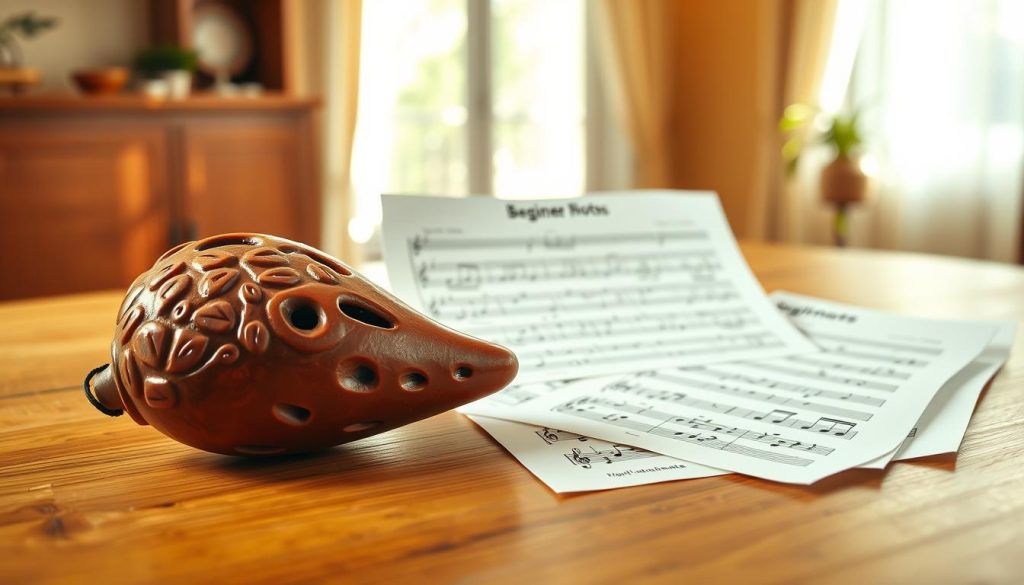
- Each diagram shows which holes to cover to produce the correct pitch.
- Managing your breath from the outset ensures a clear, whistle-free sound.
- The range depends on the model, but you can play simple songs in your very first session.
| Type | Advantage | Audience |
|---|---|---|
| Visual diagram | Quick reading of hole positions | Beginners |
| Standard notation | Precise pitch and rhythm | Musicians seeking to expand their repertoire |
| Hybrid | Clarity and precision | All levels |
To go further, see our detailed explanation of reading music and notation.
Understanding the visual structure of tablature
The visual structure helps translate notation into concrete actions. A diagram precisely shows each hole and the position of the hands. This makes reading faster for beginners who want to identify a piece’s range and key.
How the holes are represented
On a 12-hole instrument, diagrams show the holes to cover (solid circles) and those to leave open (empty circles).
Each note appears as a diagram. The illustration shows the position of each hand and identifies the side holes reserved for the thumbs.
Reading notes in sequence
Read from left to right, as you would a book. The spacing between diagrams helps you manage tempo and note duration.
- Follow the sequence of diagrams to maintain the progression of notes.
- Pay particular attention to the side holes and thumb fingerings.
- The staff and rhythmic notation can supplement the score for greater precision.
By observing the visual structure, you will quickly identify your instrument’s range and the note variations throughout the song.
Model-specific fingering features
The key and design of the instrument significantly affect finger positions. An alto in C will not use the same fingerings as a model tuned to G. This difference changes how you read diagrams and approach each note.
Your choice of type, particularly between 6-hole and 12-hole models, requires distinct fingerings. Twelve-hole instruments offer a wider range but require more practice to memorize the positions.
How the key affects playing
The key determines the pitch and therefore the correspondence between holes and notes on the score. Good breathing technique is necessary to maintain consistent airflow control during rapid changes.
- Check that your instrument is compatible with the selected score.
- Controlling air pressure ensures a clear tone, regardless of the key.
- Materials (ceramic or plastic) change how the instrument feels, but not the principles of reading music.
| Type | Number of holes | Advantage | Effect on fingerings |
|---|---|---|---|
| Small | 6 | Easy to learn | Simple fingerings, limited range |
| Medium | 12 | Wider range | More numerous and precise fingerings |
| Alto in C | Variable | Lower pitch | Positions differ from those of a model in G |
For a guide dedicated to 6-hole models, see our article on playing a 6-hole ocarina. Understanding the key will help you avoid the fingering mistakes beginners commonly make.
Deciphering traditional flute sheet music
The staff and bar lines are the essential reference points for deciphering a score in 4/4 time. This framework shows note pitches on the staff and organizes the tempo with bar lines. A measure in 4/4 serves as a reference for distinguishing whole, half, and quarter notes.

Key points to remember:
- Standard notation uses a staff to represent each note; this requires some knowledge of music theory.
- Learn duration symbols (whole, half, and quarter notes) and rests; they govern the rhythm.
- Slurs and augmentation dots alter a note’s actual duration.
Each note on the staff corresponds to a precise fingering on your instrument. Flute sheet music can often be transposed for ocarinas, provided their range is respected. Beginners may find traditional notation dense, but it offers unmatched precision for performing demanding works.
For a practical exercise, begin with a short melody in 4/4 and identify each note value. If necessary, follow a guided tutorial such as a step-by-step example.
Using hybrid tablature to improve
Hybrid documents provide a visual and theoretical key that connects each written note to its actual fingering. They combine the traditional staff with hole diagrams to simplify learning.
For beginners, this approach is ideal: it lets you play songs quickly while learning note names and finger positions.

- Gentle progression: you become more independent without losing contact with the instrument.
- Visual memory: matching each note to its fingering speeds up memorization.
- Compatibility: some instruments are designed for this type of score, making the transition to more professional playing easier.
- Resources: when documents are scarce, online tutorials can help you create or find combined scores.
By combining these two systems, you improve your understanding of music and your dexterity on the holes. To learn more about reading and access examples, see our guide to reading hybrid sheet music.
Practical tips for fluent reading
A short, regular routine will quickly transform your music-reading skills. Practice for 15 to 20 minutes a day to memorize fingerings and develop muscle memory.
The importance of breathing: control your breath by practicing long notes. Begin by holding them for two to four beats to stabilize the pitch.
“Breathe calmly and exhale steadily to produce a clear sound.”
Regular practice: divide your sessions into a warm-up, fingering exercises, and then reading a short score. This makes it easier to improve across the full range and through changes of key.
Active listening: record yourself and compare your performance with reference melodies. Your ear guides you on tempo, dynamics, and intonation.
- Tip: make sure each hand covers the holes completely to prevent air leaks.
- Reminder: pay attention to rhythmic notation (standard notation or tablature) to observe note durations.
By maintaining this discipline, you will decipher any score more quickly and gain control and technique.
Conclusion
Reading the symbols on a score turns your breath into an accessible melody.
Learning to read tablature and diagrams is a rewarding step that opens the world of music to every beginner. This article has given you clear tools to decipher a score and master your instrument with confidence.
Patience and regular practice remain your best allies. Work on your breath and fingerings for a few minutes each day to progress quickly.
Feel free to read this guide, share your progress, and explore the ocarina collection to enrich your musical journey.