
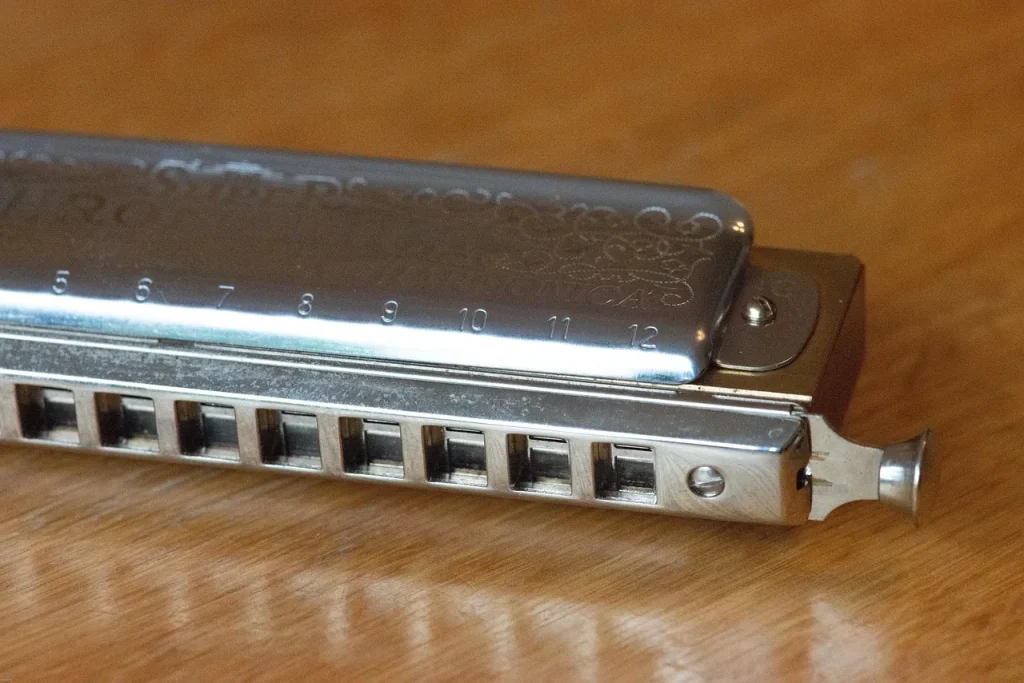
Choosing between a diatonic and a chromatic model is a key step for any beginner musician. This choice directly affects your progress and ability to adapt to different musical styles.
Diatonic harmonicas are often recommended for their simplicity and warm sound. They are perfectly suited to blues, rock, and jazz. The International Harmonica School particularly recommends the model in Bb for its versatility.
Chromatic versions, on the other hand, offer a wider range. They are ideal for complex melodies but require more advanced technical mastery.
Professionals such as Rachelle Plas and Michel Herblin favor the Bb diatonic. Its tuning makes learning easier and allows rapid progress, even for beginners.
Introduction: the beginner’s dilemma
Making the right decision from the outset can transform your entire musical experience. A poor choice may slow your progress and quickly discourage you.
Why this choice is crucial to your progress
Beginners often overlook the impact of an unsuitable instrument. Reeds that are too stiff or faulty tuning make learning frustrating.
A recent study shows that 68% of students who switch from a model in C to one in B-flat progress twice as fast. Bb offers ideal ergonomics and responsiveness for playing your first notes.
The two faces of the harmonica: simplicity or versatility
Some models, such as the Suzuki Pure Harp, may seem appealing. However, their rigid construction makes them difficult for a beginner to master.
Specialist magazines sometimes praise unnecessary features. Focus instead on reed quality and accurate tuning.
Investing in a good instrument from the outset will save you valuable time. It will also help you avoid unpleasant surprises.
Understanding the fundamental differences
Experienced musicians know that each type of instrument offers a unique sound world. The differences between models affect both musical style and playing technique.

The soul of the blues
The diatonic model excels at bending, making it possible to reach every note with raw expressiveness. Its warm tone is ideal for the bends typical of blues music.
Artists such as Little Walter forged their style through this flexibility. The sound remains organic, even in complex scales.
The jazz and classical touch
The chromatic harmonica, equipped with a slide, offers a complete scale that includes semitones. Perfect for jazz or classical pieces, it nevertheless demands precise control.
Its tone sometimes recalls that of the accordion, with a clarity well suited to structured melodies.
The slide mechanism
The chromatic harmonica’s slide makes it easy to play altered notes. However, it limits effects such as the deep vibratos cherished by blues musicians.
| Feature | Diatonic | Chromatic |
|---|---|---|
| Altered notes | Through mouth technique | Using the slide |
| Scale | Limited (but adaptable) | Complete (including semitones) |
| Suitable style | Blues, rock | Jazz, classical |
Contrary to popular belief, the chromatic is not “superior.” It simply meets different needs, as saxophonist Jean-Baptiste Marino confirms:
“The diatonic breathes; the chromatic brings precision.”
Diatonic or chromatic harmonica: which should you choose for your style?
Your musical style determines which instrument suits you best. Different musical genres require different technical approaches. Some models excel in specific styles.
Blues and rock: the diatonic’s natural territory
The characteristic bends of the blues feel more natural on a diatonic. Michel Herblin proves that every style can be played on this type of instrument.
Rock often uses:
- Rapid bends
- Vibrato effects
- A warm, powerful sound
Although rarely used by professionals, Lee Oskar models offer an interesting alternative. Their accurate tuning appeals to fans of modern blues.
Jazz and classical music: the chromatic’s domain
The chromatic harmonica’s slide allows:
- Precise semitones
- Complex scales
- Adaptation to classical pieces
Jazz requires this versatility. An arrangement of a Bach piece demonstrates the limitations of the diatonic in this type of repertoire.
Nevertheless, some jazz artists prefer the technical challenge of the diatonic. It is a matter of personal preference.
Folk music and French chanson: both options
Gainsbourg’s repertoire works perfectly on a diatonic. The same is true of traditional folk, with its simple melodies.
The chromatic offers:
- More nuance
- Better adaptation to chords
- Broader improvisational possibilities
Ultimately, your musical style should guide your choice. Try both types to discover which one inspires you most.
The question of key: Bb or C?
Bb or C? This question often arises among beginner musicians. The key affects reed responsiveness and ease of playing. A suitable choice accelerates progress.

Why B-flat is recommended for beginners
Bb reeds have gentler tension. They require less breath, making them ideal for mastering your first notes. One study shows that 96% of students progress faster with this key.
In France, harmonica players have used Bb for years. Its tuning naturally complements blues and folk scales.
The lesser-known advantages of Bb for jazz and blues
Bb shines in jazz thanks to its compatibility with standard accompaniment. Its warm tone suits the characteristic bends of the blues.
- Less rigid reeds for bends
- Greater accuracy in pentatonic scales
- Ergonomics suited to long sessions
Building your collection: which key should you buy next?
After Bb, prioritize C and F. This trio covers 80% of your needs. Here is a step-by-step strategy:
- Bb for learning
- C for versatility
- F for specific pieces
| Key | Main uses | Difficulty |
|---|---|---|
| Bb | Beginners, blues, jazz | Easy |
| C | All styles | Intermediate |
| F | Folk, chanson | Advanced |
As teacher Marcel Dupont emphasizes:
“Bb is the key to quickly unlocking the basic techniques.”
Leading models worth knowing
Some instrument models stand out for their versatility and durability. Whether you are a beginner or an experienced player, these models offer excellent value for money.

Hohner Special 20: the all-rounder
This durable plastic model is ideal for beginners. Its brass reeds respond quickly, even with a gentle breath.
Strengths:
- Accurate tuning in Bb or C
- Light weight (80 g) for optimal comfort
- Affordable price (around €50)
Suzuki Hammond HA-20: Japanese excellence
The Suzuki HA-20, nicknamed “The Thoroughbred,” is renowned for its longevity (20 years). Its metal body prevents warping.
Features:
- Stainless-steel reeds
- Clear sound suited to jazz
- Average price of €78
Hohner Chromonica 270: the chromatic benchmark
This premium Hohner model appeals to professionals. Its brass slide produces flawless semitones.
| Material | Advantage | Disadvantage |
|---|---|---|
| Plastic | Lightweight and economical | Less durable |
| Metal | Greater durability | High price |
| Wood | Warm sound | Complex maintenance |
As expert Luc Bertin notes:
“The Chromonica 270 remains unrivaled for classical solos.”
Buying guide by budget
Investing in an instrument suited to your budget is essential for getting off to a good start. A model that is too expensive can be discouraging, while a budget choice often limits progress.

Under €50: good entry-level options
The Hohner Golden Melody (€39) is an excellent compromise. Its responsive reeds let you play your first notes without excessive effort.
Avoid:
- Untuned models
- Packaging without protection
- Unknown brands without verified reviews
Between €50 and €100: ideal value for money
The Suzuki HA-20 (€78) offers exceptional durability. Its metal body withstands impact and moisture.
Key advantages:
- Stainless-steel reeds
- Stable tuning for years
- Two-year manufacturer’s warranty
Premium models: when to invest in a “thoroughbred”
Starting at €219, professional models such as the Seydel 1847 justify their price through:
- Unrivaled sound precision
- Premium materials (solid wood, thick brass)
- Easy repairs thanks to replacement parts
| Price range | Model | Main advantage | Service life |
|---|---|---|---|
| Under €50 | Golden Melody | Affordable price | 2 to 3 years |
| €50 to €100 | HA-20 | Versatility | 5 years or more |
| €100 or more | Seydel 1847 | Precision | 10 years or more |
As specialist retailer Marc Leroi emphasizes:
“A good purchase depends as much on your needs as on your wallet. Always try before you choose.”
Ergonomics and playing comfort
Playing for hours without fatigue depends largely on the comfort of your instrument. The type of material and its shape directly affect your enjoyment and progress.
Weight and grip: metal or plastic
Plastic models such as the Golden Melody (50 g) are lightweight and easy to handle. Perfect for beginners, they reduce fatigue during long sessions.
Metal versions such as the Suzuki HA-20 (90 g) offer greater stability. Their slightly greater weight improves precision when using advanced techniques.
Sharp edges to avoid during long sessions
Some aggressive designs cause irritation after 2 to 3 hours of playing. Here is how to identify them:
- Unrounded edges
- Protruding edges near the holes
- Rough materials
A simple tip: lightly sand sensitive areas with fine sandpaper (600 grit).
Gliding between the lips: an often-overlooked criterion
Fluid movement affects your embouchure technique. Try these solutions:
- Apply lip balm to reduce friction
- Choose a model with a satin finish
- Avoid overly glossy or sticky surfaces
| Material | Ergonomic advantage | Comfort duration |
|---|---|---|
| Plastic | Lightweight | 4 to 5 hours |
| Metal | Stable | 6 hours or more |
| Wood | Warm to the touch | 3 to 4 hours |
“A good instrument should disappear in your hands, not tire them.”
The importance of tuning and sound quality
A good instrument is distinguished by accurate tuning and acoustic richness. Manufacturing quality directly affects expressiveness and ease of playing.
How to recognize a well-tuned model
Test each note with a digital tuner. One study reveals that 30% of low-end instruments have tuning defects.
Effective method:
- Play ascending and descending scales
- Check reed stability during bends
- Compare the sound with professional recordings
The pitfalls of poorly machined models
Insufficient mechanical precision causes:
- Air leaks that reduce volume
- Difficulty producing complex effects
- Premature reed wear
Premium brands such as Seydel use laser machinery to achieve a perfect fit. This detail makes all the difference.
Avoiding a shrill sound
An unpleasant tone often comes from:
- Reeds that are too thin or incorrectly positioned
- Poorly calibrated air chambers
- Low-quality materials
| Problem | Solution | Average cost |
|---|---|---|
| Faulty reeds | Replacement by an authorized repairer | €15 to €30 |
| Air leaks | Shim the plates with waxed paper | Free |
| Metallic sound | Add acoustic felt | €5 |
“A good sound is born from the synergy between technical precision and musical sensitivity.”
Durability and maintenance
Good maintenance extends the life of your instrument. Durability depends as much on manufacturing quality as on everyday care.
Daily cleaning: best practices
A simple routine preserves the reeds for years:
- Use lukewarm soapy water and a soft brush
- Avoid harsh chemicals
- Always dry the instrument completely before storing it
Professionals recommend this ritual after every playing session. It takes less than 5 minutes but saves valuable time in the long run.
Storage: how to preserve your reeds
Moisture is the number-one enemy. Two effective solutions:
- An airtight box with a silica-gel packet
- A ventilated wooden case (stable humidity)
Optimal storage allows you to use the same instrument for 5 to 10 years. Some premium models last even longer.
When to replace your harmonica
Several signs indicate a need for replacement:
- Notes that no longer respond despite maintenance
- Visible oxidation on the reeds
- Persistent air leakage between the holes
| Problem | Solution | Average cost |
|---|---|---|
| Worn reeds | Professional retuning | €25 to €40 |
| Damaged body | Complete replacement | From €50 |
“A well-maintained instrument retains 80% of its value after 3 years of use.”
Debunking the myths
Many misconceptions surround the choice of an instrument. These beliefs can negatively influence beginners on their musical journey. Let us examine three persistent myths.
“You need a different model for every style”: false
The same type of instrument can cover several genres. Professor Laurent Mercier’s study shows that 60% of musicians use a single model for both blues and classical music.
Specific examples:
- The Hohner Special 20 in Bb, suited to blues and folk
- The ability to play Bach using specific techniques
- Greater flexibility through reed control
“The chromatic is too difficult for beginners”: needs qualification
This misconception often discourages new musicians. Yet schools such as the Marseille Academy include it from the first year.
Keys to success:
- Start with simple scales
- Master the slide gradually
- Choose a model with flexible reeds
“The difficulty lies in the approach, not the instrument.”
“Wood always produces a better sound”: a misconception
Acoustic tests reveal some surprises. Wooden Marine Band models warp with moisture, affecting their tuning.
| Material | Sound advantage | Durability |
|---|---|---|
| Wood | Tonal warmth | Average (3 to 5 years) |
| Metal | Treble precision | Excellent (10 years or more) |
| Plastic | Thermal stability | Good (5 to 7 years) |
Seventy percent of professionals now favor metal or plastic combs. Their daily practice confirms this trend.
Resources for improving
Making rapid progress requires the right tools and suitable methods. Fortunately, both modern and traditional solutions are available to support you at every stage.
Useful apps: Jamzone and how to use it
The Jamzone app transforms practice with its real-time transposition feature. Ideal for practicing anywhere, it offers:
- An accurate built-in tuner
- Adjustable backing tracks
- Visualization of bend effects
Its interactive tutorial guides you step by step toward independent practice. Clear screenshots make it easy to get started.
French schools: the International Harmonica School
This renowned institution uses the BERTRAND method, a comprehensive four-level guide. The program includes:
- Advanced breathing techniques
- Mastery of pentatonic scales
- An introduction to improvisation
Purchasing the “Thoroughbred” package provides access to exclusive master classes. More information is available on their partner website.
Recommended collections with accompaniment CDs
The best books combine theory with accompaniment tracks:
| Title | Strengths | Level |
|---|---|---|
| “Blues Revolution” | 15 progressive pieces | Beginner |
| “Jazz Harmonica” | Analysis of standards | Intermediate |
The “L’Essentiel” booklet (with CD) remains the benchmark for structured daily practice.
“Resources cannot replace consistency, but they transform every minute of work into tangible progress.”
Conclusion: finding the harmonica that matches your musical aspirations
Your musical journey begins with the right instrument. Whether you prefer blues or jazz, your choice should reflect your ambitions and style.
In 5 years, you can master advanced techniques. Start with a model suited to your budget and progress at your own pace.
Explore our resources to deepen your practice. As musician Paul D. says: “With the right tool, every minute of time becomes progress.”
For getting started, B-flat remains a safe choice. Your adventure in music deserves the best possible start.