
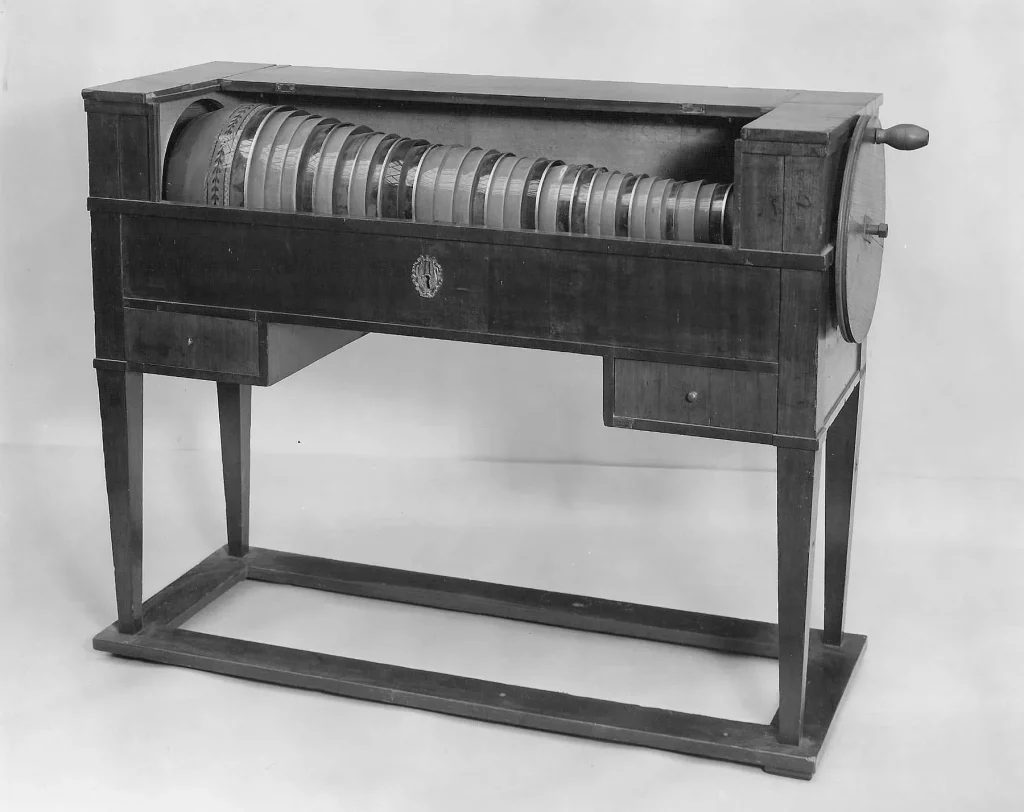
The glass harmonica is a fascinating instrument, known for its crystalline tones. Invented in 1761 by Benjamin Franklin, it made its mark on the 18th century before falling into obscurity. Today, artists such as Nils Frahm and Björk are bringing it back to life.
Its ingenious mechanism relies on rotating glass bowls operated by a pedal. Mozart and other composers even wrote pieces for this unique instrument. Yet its initial success was followed by a ban in the 19th century, as it was accused of disturbing people’s minds.
Explore its remarkable journey, from aristocratic salons to contemporary stages, in this article. To learn more about unusual instruments, explore our link.
Introduction to the glass harmonica
The crystalline sound of this instrument is produced by rubbing glasses with wet fingers. Its operating principle relies on a rotating shaft driven by a pedal, making it possible to play up to 10 notes simultaneously.
Unlike traditional musical glasses, the glass harmonica uses 37 crystal or glass bowls, tuned to cover three octaves. This innovation provides a much broader tonal range.
| Feature | Traditional musical glasses | Glass harmonica |
|---|---|---|
| Number of notes | Limited (6–12) | 37 (3 octaves) |
| Mechanism | Stationary glasses | Rotating bowls |
| Technique | Rubbed by hand | Pedal + wet fingers |
Mary Ann Davies, a forgotten pioneer, was the first to turn it into a concert instrument. Her talent left its mark on the 18th century, before enthusiasm for the instrument declined.
Today, this ingenious device continues to fascinate with its mesmerizing sound and historical legacy.
The history of the glass harmonica
Benjamin Franklin revolutionized music with a brilliant invention. His glass harmonica has endured through the ages, inspiring fascination and controversy. Here is its story, from the earliest experiments to the bans imposed on it.

The origins: from musical glasses to Benjamin Franklin
In 1741, Richard Pockrich created the verrillon, the instrument’s predecessor. But it was Franklin who perfected it in 1761. The inventor added a pedal mechanism and rotating bowls.
This innovation made it possible to play complex melodies. The instrument quickly became a highly sought-after musical curiosity in intellectual salons.
Success in the 18th century and the enthusiasm of the Enlightenment
During the century, the instrument won over Europe. More than 600 works were dedicated to it, including pieces by Mozart. Aristocrats adored its mesmerizing timbre.
Leopold Mozart owned one. Concert halls and Mesmerist treatments employed it for its hypnotic effect.
Decline and prohibition in the 19th century
In the following century, rumors accused it of causing insanity. Studies also pointed to lead poisoning caused by the lead contained in the glass.
In Germany, it was banned by the police. Despite its decline, a few enthusiasts continue to preserve its legacy today.
How it works and its distinctive technical features
The mechanical ingenuity of this instrument rests on a unique system devised by Benjamin Franklin. Its design produces a crystalline sound, combining precision with elegance.
Franklin’s ingenious mechanism
The central shaft, driven by a pedal, rotates 37 glass bowls. They are nested in descending order of size, from the lowest-pitched (25 cm) to the highest-pitched (2.5 cm).
The rotation speed affects the timbre. Slow rotation creates gentle notes, while faster rotation intensifies the harmonics.
Materials: crystal, glass, and lead
The bowls were often made from crystal or glass enriched with lead. The latter improved resonance but posed health risks:
- Lead poisoning caused by prolonged exposure.
- Lead-containing gold paint on the keys.
Modern versions use lead-free materials, such as borosilicate glass.
Playing technique: wet fingers and a pedal
The playing technique requires moistening the fingers before rubbing the bowls. The pedal controls the rotation, allowing the player to produce dynamic effects.
Unlike the modern glass harp, the instrument requires precise coordination between hands and feet.
Benjamin Franklin and other notable figures
Beyond Franklin’s invention, several artists have shaped the history of this instrument. Their sometimes forgotten contributions reveal its cultural impact.

Mary Ann Davies: the forgotten pioneer
Trained by Franklin from 1750 onward, Mary Ann Davies was the first professional performer. A child prodigy, she dazzled salon audiences before fading into obscurity after the Revolution.
Her letters describe innovative techniques transmitted through the intellectual networks of the 18th century. A recent rediscovery is finally paying tribute to her.
Mozart and his Adagio for glass harmonica
Mozart composed his Adagio K. 617 in 1791, his final chamber work. It uses crystalline resonances to create a mesmerizing atmosphere.
This rare piece, written for a blind virtuoso, shows how the instrument inspired the greatest composers.
Thomas Bloch: the modern ambassador
Thomas Bloch, a contemporary performer, has collaborated with Daft Punk and Radiohead. He even taught Michael Douglas how to play it for a television series.
His work on Blade Runner 2049 and the opera Monkey Journey proves that the instrument remains relevant today.
Myths and legends surrounding the instrument
In the 18th century, strange rumors surrounded this unusual instrument. Between superstitious fears and health risks, its history is filled with troubling anecdotes.

The “cursed” instrument and supposed insanity
In 1785, a study reported that 30 musicians had suffered nervous fits. The crystalline sounds were accused of inducing hysterical states.
Thomas Bloch explains: “The pure frequencies acted as a psychological trigger. Today, we understand these phenomena better.”
Lead poisoning: the reality behind the myth
The lead present in the glass caused poisoning. Here is a comparison between the historical symptoms and current knowledge:
| Symptoms (18th century) | Modern explanation |
|---|---|
| Tremors | Lead poisoning |
| Headaches | Prolonged exposure to lead fumes |
| Hallucinations | Combination of lead poisoning and mass psychosis |
Use in hypnosis and Mesmerist treatments
Franz Mesmer incorporated it into his trance sessions. According to historian Mélanie Traversier, the sciences of the period associated its vibrations with therapeutic properties.
The years from 1770 to 1800 saw its use decline, despite its undeniable artistic potential.
The revival of the glass harmonica today
Long forgotten, this instrument has experienced renewed interest in recent years. Innovative musicians are exploring its mesmerizing sounds, blending tradition with modernity.

Nils Frahm and neoclassical music
Nils Frahm made a lasting impression with his album “Music for Animals.” He combines rotating bowls with electronic effects, creating hypnotic soundscapes.
His technique uses distilled water to produce purer harmonics. This approach completely reinvents the traditional playing style.
Appearances in pop music and film
In film, Thomas Bloch contributed to the soundtrack of Blade Runner 2049. Pink Floyd had already used it in “Shine On You Crazy Diamond.”
Some notable works:
- Soundtrack of Amadeus (1984)
- Collaborative project with Radiohead
- Use in Netflix series
A rare instrument that is still alive
Only four professional concert performers were recorded in 2024. Production remains artisanal:
- 2 specialist instrument makers in Europe
- 80 kg to transport for each model
- Artist residencies in La Couture-Boussey
Despite these challenges, its unique sound ensures its survival. Educational projects are encouraging its return to the stage.
Conclusion: the glass harmonica, between past and future
Between past and future, this cultural object fascinates with its unique legacy. From Benjamin Franklin to contemporary stages, its history blends innovation and mystery. Designated a historic monument in 2023, it now symbolizes a bygone era.
Digital versions are emerging, combining an ancient technique with modern technology. Thomas Bloch emphasizes its role in passing this heritage on to younger generations: “Its unique timbre still captivates, even in a digital world.”
For those wishing to experience it, occasional concerts take place in France, particularly at the Philharmonie de Paris. A composer like Mozart would undoubtedly have embraced it today.