
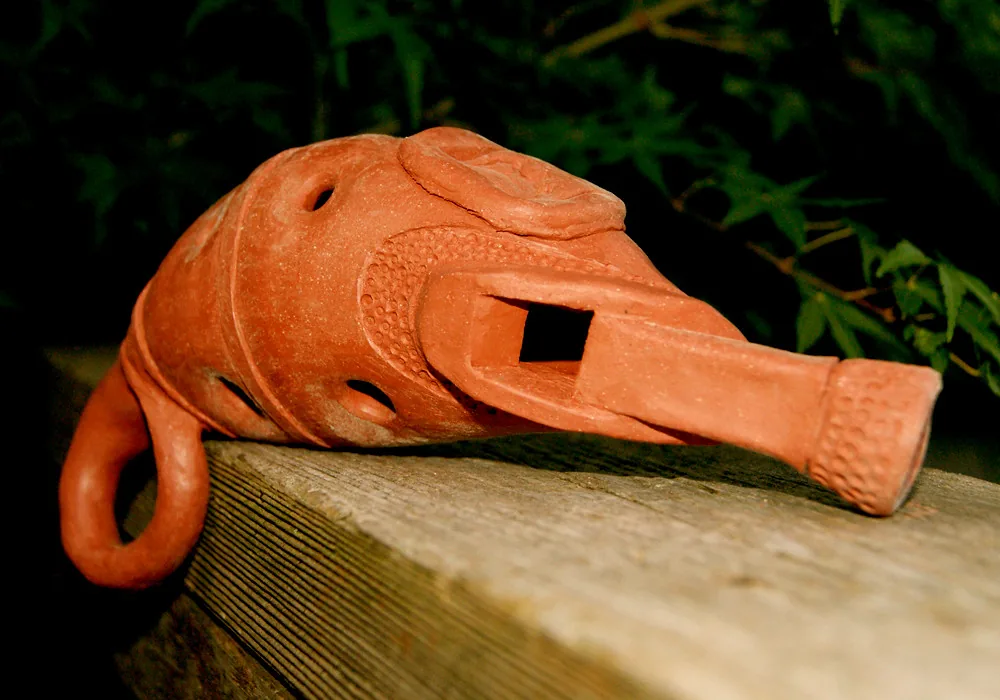
An instrument for all ages. Jean, 72, shows that it is never too late to start. His example illustrates just how appealing this compact instrument is to beginners and how quickly it brings genuine enjoyment.
A simple, structured method helps you progress in very little time. By following clear advice, you will be able to play your first melodies in just a few weeks.
Choosing your first ocarina is crucial to having an enjoyable and effective experience. This guide takes you through the process step by step so you can learn to play and get the most out of making music.
Understanding the history and appeal of the ocarina
The ocarina carries thousands of years of history and a charm that spans continents.
Originating in Mayan and Aztec cultures, this wind instrument was used in sacred rituals. Its early form traveled with peoples and traditions.
In 1853, Giuseppe Donati modernized the ocarina. He gave it the shape and melodic precision we know today.
- Unique resonance: the internal cavity creates rich, warm sounds.
- Connection across time: it links ancient practices with contemporary musical uses.
- Accessibility: its simplicity explains its growing popularity around the world.
How to learn to play the ocarina easily
Simple techniques are enough to produce clear sounds within a few weeks. This section presents two practical ways to make rapid progress.
Self-teaching methods
Online resources offer beginners step-by-step lessons. They cover fingerings, breathing exercises, and easy pieces.
Benefit: no expensive lessons and the freedom to progress at your own pace. These techniques make learning practical and motivating.
For a guided learning path, consult a complete guide containing exercises and advice.
The importance of regular practice
Daily practice, even for just five minutes, reinforces what you have learned. Before long, you will be able to play complete melodies.
- Repetition improves breath precision and motor memory.
- Short, regular practice sessions accelerate your progress on this wind instrument.
Conclusion: combining self-teaching methods with regular practice turns an initial attempt into genuine musical enjoyment.
Choosing the ideal beginner model
The type of ocarina you choose directly affects your comfort and progress.
Choosing a suitable model makes the instrument easier to handle. A good wind instrument reduces frustration and encourages regular practice.
Transverse or pendant
A transverse ocarina generally has 10 to 12 holes. It is suitable for adults who want to explore a wider range of notes and develop their technique.
The smaller pendant ocarina often has 4 to 6 holes. It is ideal for children and beginners because it simplifies the fingerings.
- Ergonomics: the hole layout makes the instrument easy to hold, regardless of hand size.
- Progress: the type of ocarina quickly influences your musical development.
- Recommendation: choose according to your goals—simplicity or a wider range.
For a guided learning path and advice on choosing an instrument, consult this beginner’s guide to the ocarina.
Differences between manufacturing materials
The material immediately transforms the character of your ocarina’s sound.
Ceramic offers a warm, deep tone. Ceramic models produce the harmonic richness valued in music. They are well suited to players seeking a beautiful tone color.
Plastic is lightweight and durable. These instruments are perfect for beginners. Plastic withstands impacts better and makes daily practice easier.

- Sound quality: ceramic = warm sound; plastic = clear, stable sound.
- Care: each type requires specific care to remain in tune.
- Durability: plastic > ceramic for intensive use.
| Material | Sound | Durability | Recommended players |
|---|---|---|---|
| Ceramic | Warm, rich | Fragile | Intermediate and advanced players |
| Plastic | Clear, consistent | Very durable | Beginners and children |
| Wood (optional) | Natural, diffuse | Moderately durable, requires maintenance | Enthusiasts seeking warmth |
Practical advice: adapt your choice to your skill level and intended use. The right choice prevents frustration and supports progress.
Adopting the perfect playing posture
Standing or sitting upright frees your breath and makes notes easier to control. The “tree” posture should be simple: feet firmly planted, spine aligned, and shoulders relaxed.
To hold your instrument correctly, keep it close to your body without becoming rigid. This position facilitates diaphragmatic breathing and reduces fatigue.
- Fingers on the ocarina: position them so they cover the holes without pressing too hard. Relaxed fingers prevent air leaks.
- Breathing: proper spinal alignment promotes a stable, deep breath.
- Lip pressure: apply moderate pressure to the mouthpiece to produce clear notes without whistling.
Practical advice: beginners will become more agile by working on relaxed fingers and regular breathing. Good posture improves sound quality and makes the music more enjoyable.
Mastering diaphragmatic breathing
Learning to direct air from the diaphragm makes it easier to play notes in tune. This type of breathing is one of the key techniques for producing clear first notes on a wind instrument.
The candle exercise
Place a candle in front of you and blow gently so that the flame flickers without going out. This simple exercise teaches breath control.
Repeat the exercise for one minute, three times a day. Each note will then become more stable and consistent.
Breath management
Breath management strengthens the abdominal muscles and improves musical endurance. Practice in short sessions and gradually increase their duration.
By positioning your fingers precisely, you allow air to flow freely through the ocarina, improving both the pitch and the sound quality.
For additional exercises and resources on how to improve at the ocarina, consult practical guides. To find tablature useful for beginners, see our recommendations.
The hole-numbering system
Hole numbering provides a simple map for finding each note. On most six-hole models, the holes are numbered from 1 to 6. Hole 1 is generally located at the bottom. This reference helps beginners position their fingers quickly.
This system serves as a visual tool for associating each number with a specific position. In practice, cover the indicated hole to produce the corresponding note. Modern sheet music often shows these numbers to make reading easier.
A useful exercise is to say the number aloud and then place your finger. Slowly repeat the scale while following the numerical sequence. This exercise strengthens motor memory and air control.
“The lower reference point—hole 1—often serves as the anchor for building the scale.”
- Tip: use online diagrams and sheet music to visualize fingering techniques.
- Result: a quick association between numbers and fingers that accelerates learning.
Learning the fundamental fingerings
Clean fingering is essential for producing accurate notes on a six-hole instrument.
Start by memorizing each position. Work slowly and check that every hole is completely covered, one at a time. An air leak at the lower hole immediately changes the note’s pitch.
Features of six-hole models
Six-hole models offer a wider range of sounds. They allow you to explore a variety of techniques and rapid note sequences.
- Position your fingers so that they cover the holes without pressing too hard.
- Use the OcarinaTuner app to check the frequency of each note.
- Follow fingering diagrams to develop reliable muscle memory.
| Aspect | Advice | Effect | Players |
|---|---|---|---|
| Finger position | Cover the holes completely | Stable notes | Beginners |
| Lower-hole control | Check the lower hole first | Improved intonation | All levels |
| Use of tools | OcarinaTuner and diagrams | Quick tuning | Students and enthusiasts |
| Practice | Short, regular sessions | Muscle memory | Beginners and experienced players |
“Precise fingering transforms a rough melody into genuine music.”
Playing your first major scale
Begin the scale with a slow breath to establish a clear sequence of notes.
On an ocarina in C, the C major scale is played by gradually uncovering the holes. Set a metronome to 60 BPM to maintain a steady tempo.
Exercise: play each note for one measure, then ascend and descend the scale. This routine helps beginners memorize the finger position for each hole.
Regular practice turns a simple exercise into genuine learning. The range of notes and repetition develop air control and fingering precision.
- Tip: begin slowly, then increase the tempo once the notes remain stable.
- Result: better intonation and a better understanding of harmonic structure.
“Regular scale practice makes every note more reliable and facilitates the exploration of other scales.”
Exercises for developing agility
Playing across two octaves is an excellent exercise for developing finger agility and mastering high notes.
Begin slowly and ascend through two octaves, controlling the air at every transition. Practice one phrase, then repeat it while gradually increasing the tempo.
For variety, use MuseScore to transpose more complex scales. This helps you incorporate faster notes without losing the melodic line.

- Practice across the octaves while focusing on each note; be precise with the lower hole and the other holes.
- Link scales and speed exercises to make your finger movements more fluid.
- Maintain consistent air-management technique, even during fast passages.
“Regularly practicing this exercise makes every note in the scale clearer and more expressive.”
| Goal | Duration | Effect |
|---|---|---|
| Playing across 2 octaves | 5–10 min | Finger agility, accurate high notes |
| Speed (fast scales) | 4–6 min | Fluid movement |
| Transposition with MuseScore | 3–5 min | Adaptation to more complex notes |
Reading tablature to make progress
Well-read tablature becomes a guide for every note. It translates fingerings into numbers and makes a large number of pieces accessible.
Each number corresponds to a specific hole. This is a simple example of how to position your fingers on the instrument.
Benefits: you can play pieces such as “Zelda’s Lullaby” without knowing how to read conventional notation. Reading focuses on coordinating your breath and fingers.
- Reading tablature is essential for quickly learning popular pieces.
- The numbers show exactly which hole to cover at any given moment.
- Sites such as OcarinaTabs.org offer thousands of scores for practicing each note.
“Tablature turns a complex score into an immediate visual guide.”
By following these diagrams, the exercise helps you synchronize breathing and fingering. The result is a smoother, more harmonious melody.
Deciphering classical sheet music
Deciphering a score becomes manageable once you understand the logic of melodic lines.
Begin by identifying the treble clef and note durations. These symbols guide the rhythm and the length of the sounds.
Choosing a type of score: select arrangements suited to your level. Piano scores often require complex fingerings when played on an instrument with holes.
Use MuseScore to transpose pieces automatically and adjust their range. “The Art of Ocarina” helps convert piano scores into playable versions.

Learn to read accidentals and scales. A simple exercise is to identify the melodic line and then vocalize the phrase before playing it.
“Progressive reading turns an intimidating score into an approachable piece.”
- Practice difficult phrases slowly.
- Transposition makes pieces easier to adapt.
- Every reading session improves accuracy and interpretation.
| Aspect | Advice | Effect |
|---|---|---|
| Clef and rhythms | Identify the clef and note values | Faster reading |
| Type of score | Choose according to your level | Suitable fingerings |
| Transposition | Use MuseScore | Adaptation to the instrument’s range |
To find practical resources and tablature, consult a detailed guide to reading sheet music. This link directs you to concrete examples and targeted advice.
Advanced techniques for enriching your playing
Combining breathing methods with musical analysis opens up new sonic possibilities. These techniques aim to bring more color and control to every note.
Diaphragmatic vibrato
Vibrato must be mastered to enrich the sounds produced by your ocarina. Claudio Colombo’s method uses the diaphragm to modulate the airflow precisely.
Effect: greater expressiveness without sacrificing intonation.
Tempo control
Stabilizing the tempo makes musical phrases easier to understand. This breath-control exercise helps maintain a steady pulse.
Practice with a metronome, then vary the dynamics to improve precision and musicality.
Analyzing complex pieces
Studying more complex pieces, such as “Flight of the Bumblebee,” develops speed and precise finger placement over the holes.
- Break the phrase into small sections.
- Repeat slowly before speeding up.
- Observe the relationship between breath and fingers for each note.
“By incorporating these techniques, you progress from an amateur level to advanced mastery of the instrument.”
To explore fingerings in greater depth, consult a guide to fingering systems.
Avoiding common beginner mistakes
Recurring mistakes often result from poor coordination between breath and fingers. First determine whether wrong notes are caused by air pressure or incorrect finger placement.
68% of beginners correct their intonation problems within three weeks by using a digital tuner such as OcarinaTuner. This tool helps you visualize each note and quickly correct its pitch.
To avoid wrong notes, practice this exercise in front of a candle: blow gently to keep the flame steady. It strengthens your breathing and stabilizes each note you produce.

- Check the position of your fingers over the holes: even a slight shift affects the pitch.
- Practice transitions between more complex pieces slowly to avoid mistakes.
- Follow this advice to improve your technique and progress quickly.
| Problem | Action | Result |
|---|---|---|
| Poor intonation | Use OcarinaTuner | Correction within 3 weeks |
| Unsteady breath | Candle exercise | More stable notes |
| Imprecise fingering | Correct finger placement over the holes | Improved intonation |
“Precise fingers and breath transform a hesitant note into polished music.”
Maintaining your instrument for maximum longevity
Your ocarina’s longevity depends on simple, regular care. Daily maintenance prevents moisture buildup and protects the delicate holes.
After every use, wipe the ocarina with a soft cloth. This habit protects the ocarina’s holes from corrosion and residue.
Once a week, perform a cleaning exercise: direct a jet of compressed air into the cavities, then brush them gently with a lint-free cloth. This keeps the air passages clear and preserves the accuracy of every note.
For transport, choosing a hard case such as a Pelican or Noblex is recommended. These models protect the instrument from impacts and changes in humidity, which is essential for preserving its tone color.
| Action | Frequency | Effect |
|---|---|---|
| Wipe after use | After every session | Protects the holes and surface |
| Air cleaning | Weekly | Clear cavities, stable notes |
| Protective case | At the time of purchase | Safe transport |
“Thorough maintenance should be incorporated into your routine to preserve a pure sound.”
Conclusion
Over time, consistency and a good instrument reveal the true enjoyment of playing. Mastering the ocarina is an accessible adventure. With short sessions, you will produce your first notes and develop a more confident melodic line.
Like Jean, aged 72, you can enjoy music with the help of online resources such as Feria Musica. Choosing a good ocarina and following simple advice will accelerate your progress.
Download free sheet music to expand your repertoire. Start now: this is the perfect time to learn to play and join a community that shares your enthusiasm for this wind instrument.