
Step into the universe that transformed a simple instrument into an icon. This article explores how this object became central to the legend of Hyrule and to players’ hearts.
In Ocarina of Time, the ocarina’s role extends beyond gameplay. Each melody opens doors, alters time, and links the past to the present.
While passing through the Temple of Time, the player realizes that this instrument functions as a narrative symbol. Its presence guides the quest and tells a long story of bravery.
This introduction presents the key themes: the object’s origin, its musical power, its cultural influence, and its legacy among fans in France and elsewhere.
Introduction to the Ocarina of Time
The year 1998 saw the release of a game in which a simple instrument redefined the hero’s progression. The concept places the player at the heart of an adventure combining exploration and time manipulation.
In this universe, the object’s role goes beyond that of a mere inventory item. It opens routes, enables travel between two eras, and reveals secrets of Hyrule.
The Temple of Time is a constant landmark. It reminds us that the quest is not merely physical but also connected to the player’s choices across time.
Many players quickly realized that this instrument was becoming a genuine symbol of the series. Its influence extends to the gameplay, narrative, and visual universe of the game.
For a more detailed overview, see the introduction to the ocarina.
| Element | Function | Key location | Impact on the player |
|---|---|---|---|
| Instrument | Time manipulation | Temple of Time | Opens narrative paths |
| Quest | Triggers events | Hyrule Field | Strengthens the bond with the hero |
| Symbol | Visual identity | Town and dungeons | Leaves a lasting impression on players |
The Legend of Zelda and the Ocarina: The History of a Symbol
Few game objects have made such an impression on the collective imagination as this instrument. It serves as both a progression tool and a visual landmark within the game’s universe.
An iconic object
This instrument has become the series’ most recognizable symbol. It transcends the games and has left its mark on the history of digital entertainment.
A timeless icon
In the story, magical objects grant access to the temple and advance the quest. The player soon understands that this instrument manipulates time, a unique role among the game’s objects.
- A cultural symbol rooted in players’ memories.
- A key function in opening paths and revealing secrets.
- The exclusive ability to alter time through gameplay.
| Attribute | Role | Impact |
|---|---|---|
| Instrument | Activates melodies | Narrative progression |
| Magical objects | Opens locations | Expanded exploration |
| Symbol | Visual identity | Cultural resonance |
Origins and Development at Nintendo
In 1995, the team led by Shigeru Miyamoto laid the foundations for an ambitious Nintendo 64 title.
The project required several years of research.
A new system, named Z, made it possible to explore 3D and innovate in gameplay.
The final version of the instrument was designed to fit into the temple and the story.
The teams tested each object to improve the player experience.
“Every design choice had to serve the game and its narrative.”
Work on this title showed that the move to 3D was not simply a visual change.
It was a new way to tell stories and bring time to life in games.
| Element | Role | Impact | Years of work |
|---|---|---|---|
| Direction | Creative supervision | Consistent vision | 1995–1998 |
| Z system | Technical foundation | Innovative 3D gameplay | Several years |
| Final version | Integration of the instrument into the temple | Greater immersion | Testing and adjustments |
The Triforce’s Profound Symbolism
The Triforce embodies the primordial forces guiding every stage of the adventure. It structures the narrative universe and gives meaning to the hero’s quests.
More than a mere emblem, the Triforce connects the sacred elements. In the game, this sacred object magnifies the role of the instrument and the other precious objects.
The Virtues of Courage and Wisdom
The fragment of Courage drives the hero to act in the face of danger. The fragment of Wisdom guides decisions and protects the world.
- The Triforce unites Courage, Wisdom, and Power to form a sacred whole.
- The instrument acts as a link between these three divine elements.
- When the hero plays, time seems to stand still, revealing a profound connection with power.
| Attribute | Role | Impact |
|---|---|---|
| Courage | Action and bravery | Opens paths |
| Wisdom | Decision and protection | Reveals secrets |
| Power | Material strength | Stability of the world |
In short, the Triforce transforms every object connected with the legend into a trace of the primary elements. This sacred symbol deepens the adventure and gives the instrument an essential role in saving the world.
The Narrative Role in Link’s Quest
From the opening act, this instrument guides Link’s destiny and the player’s choices.
At the beginning of the game, it provides access to Hyrule Castle and makes it possible to retrieve the Master Sword. This passage sets the tone for the adventure.
Upon reaching adulthood, the hero uses this object to travel across the world. He then confronts the temple’s dangers and uncovers hidden parts of the story.
The relationship between the princess and the hero grows stronger through this instrument. It becomes a true symbol of destiny, linking quest and duty.
Hyrule Castle provides the setting for several decisive events. There, the Master Sword and music come together to seal the world’s fate.
Each time Link plays, he affirms his role as protector. This object does more than solve puzzles: it places the hero at the heart of the legend.
- Access to Hyrule Castle and the Master Sword.
- Journey into adulthood and trials in the temple.
- A stronger heroic bond and protection of the world.
| Moment | Narrative role | Impact |
|---|---|---|
| Beginning | Opening the castle | Obtaining the sword |
| Transition | Journey into adulthood | Exploring the world |
| Climax | Temple and confrontations | Sealing destiny |
Mastering Melodies and Musical Interactions
Melodies play a central role in progressing through the game. They open paths, alter time, and prompt reactions from characters. Understanding each tune becomes essential to the quest.

The Song of Time
The Song of Time can manipulate key moments. It slows down or accelerates certain events. This song sometimes opens passages in the temple and reveals hidden mechanisms.
Zelda’s Lullaby
The lullaby is gentle but powerful: it activates platforms and calms guardians. Its use is often associated with water and the adventure’s aquatic puzzles.
Learning from NPCs
Players do not obtain the tunes on their own. They learn them from key characters who teach them how to play. This transmission strengthens the connection between the instrument and the story.
- Precise mastery of melodies guarantees progression.
- Each song is a key to solving puzzles.
- A missed note can jeopardize an important stage of the quest.
| Song | Effect | Location type |
|---|---|---|
| Song of Time | Time control | Temple |
| Lullaby | Activates mechanisms | Aquatic areas |
| NPC lessons | Transmission | Villages |
Time-Manipulation Mechanics
Time manipulation structures the entire core mechanic that allows the hero to move from childhood to adulthood.
This system transforms the game into a two-level experience. The instrument creates a passage between two eras. This choice left a lasting impression on players for years.
The temple is where this power is activated. There, the hero can change the course of events and open blocked routes.
Through this system, the world reveals two different sides. The puzzles require thinking in terms of time. Players must master this object to move forward.
- A mechanic connecting exploration with the game’s narrative.
- A temporal passage that renews the challenges of adventure games.
- A striking development: adulthood becomes a gateway to new quests.
| Element | Role | Impact |
|---|---|---|
| Time system | Time control | Dual exploration of the world |
| Instrument | Creates a passage | Solves puzzles |
| Temple | Activation | Key narrative point |
Dungeon Exploration and Puzzle-Solving
The dungeons compel players to combine careful thought with a sense of timing to progress.
The Water Temple remains the most famous trial. It requires changing the water level, playing melodies, and using objects at the right moment.
The Water Temple Challenge
At the beginning of the quest, the hero explores Hyrule Castle to find the Master Sword and prepare for the dungeons. Without this sword, some areas remain inaccessible.
In the Water Temple, each room requires the player to use the Song of Time to raise or lower the water level. Its mechanisms include levers, doors, and platforms controlled by the instrument.
- The Water Temple requires the coordinated use of melodies and objects to reach the end.
- Combining the Master Sword with musical powers solves puzzles in the castle and dungeons.
- Each temple is designed to make the instrument indispensable.
| Dungeon | Main challenge | Required tools |
|---|---|---|
| Water Temple | Water-level manipulation | Song of Time, aquatic objects |
| Central dungeon | Mechanical puzzles | Master Sword, levers |
| Crypts | Combinations and keys | Melodies, special objects |
Emotional Bonds Between the Characters
Moments shared around a tune transform the relationship between the hero and his companions.
In this game, the instrument becomes more than a simple object: it serves as a bridge between hearts.
The characters create memories through music. A moment of silence followed by a melody is enough to reveal fears or hopes.
The princess occupies a central place in this narrative. Her connection to the instrument deepens her intimacy with the hero and gives meaning to the quest.
The Temple of Time becomes a place of reunion. There, the sword and instrument mark a decisive moment for the legend and for human relationships.
- Music seals bonds of friendship during the adventure.
- Wordless exchanges enrich the group’s story.
- Each melody recalls why the quest unites these characters.
To explore the relationship between music and gameplay further, see music and gameplay.
The Impact of Koji Kondo’s Soundtrack
The themes composed by Koji Kondo give voice to the hero’s journey.
His music plays a central role in the game. Each melody acts as a song accompanying the hero at every stage of the quest.

The Temple of Time gains power from an iconic theme. This musical passage turns the instrument into the heart of the game’s sonic universe.
The music changes between childhood and adulthood. This technique deepens immersion and makes the player feel that the world is changing.
The melodies are not mere tunes: they have a narrative role. Whenever a song sounds, the story moves forward and emotions intensify.
- A memorable composition that transcends the game.
- Themes connecting places, characters, and time.
- An instrument that became an auditory symbol for players.
The Ocarina in Majora’s Mask
In Majora’s Mask, the ocarina once again becomes a survival tool in a collapsing world.
The game imposes a strict time horizon: a three-day cycle threatening the planet. The hero must use song to gain time and postpone the end.
The Three-Day Cycle
The central mechanic relies on repetition. At the beginning of each cycle, the player returns to the save point. Items and progress are retained, but time starts over.
This constraint turns the quest into a race against time. Strategy requires planning actions and using the instrument wisely.
Interactions with Masks
Masks change how the player interacts with the world. Some grant abilities that provide access to dungeons or the hidden castle.
Music and melodies remain essential. A well-placed song activates NPCs or reveals secrets connected to the masks.
- The object’s role: reversing the course of time and saving lives.
- The instrument preserves accomplishments from one cycle to the next.
- Music symbolizes resistance to the apocalypse.
| Element | Function | Impact |
|---|---|---|
| Three-day cycle | Time limit | Constant urgency |
| Masks | Transformation | New interactions |
| Instrument | Time manipulation | Survival and exploration |
References and Legacy in Popular Culture
The presence of these melodies in contemporary culture shows how far they have moved beyond the game. It is a fact: the tunes are performed in concerts, covers, and viral videos.

This legacy extends into the world of visual and sonic arts. Creators draw inspiration from the themes to compose, reinterpret them, or incorporate elements into other games.
The instrument’s history proves that it is far more than a simple object. It embodies a legend and sometimes becomes a symbol adopted by the community.
- Influence on modern games and independent projects.
- Frequent references whenever music evokes nostalgia.
- Celebrations at events, concerts, and exhibitions.
In short, the cultural reach of this motif confirms its status. The melodies continue to inspire and connect several generations of players.
Technical Analysis of the Nintendo Version
The Nintendo 64 version pushed technical boundaries with its 262 Mb cartridge. This capacity made it possible to offer a rich adventure, detailed dungeons, and memorable music.
The targeting system and management of the Water Temple remain remarkable, even after many years. These design choices still influence how exploration games are created.
At the beginning, the player obtains the sword and musical object that launch the quest. This simple, effective mechanic served as a model for other titles.
- 262 Mb cartridge: textures and lengthy scenes.
- Targeting system: smooth progression through the temples.
- Melodies and music: narrative and gameplay support.
| Element | Role | Impact |
|---|---|---|
| N64 version | Technical platform | Greater immersion |
| Water Temple | Time-based puzzles | A design benchmark |
| Melodies | Activates mechanisms | Memorable to players |
“This edition remains a landmark in video-game history, praised for its music and dungeons.”
In short, the version still inspires players’ passion today, and some return to it after twenty years.
The Instrument’s Evolution Across the Series
Across the installments, the instrument evolves and redefines its role in each new game. The mechanics change, but music remains central to the experience.
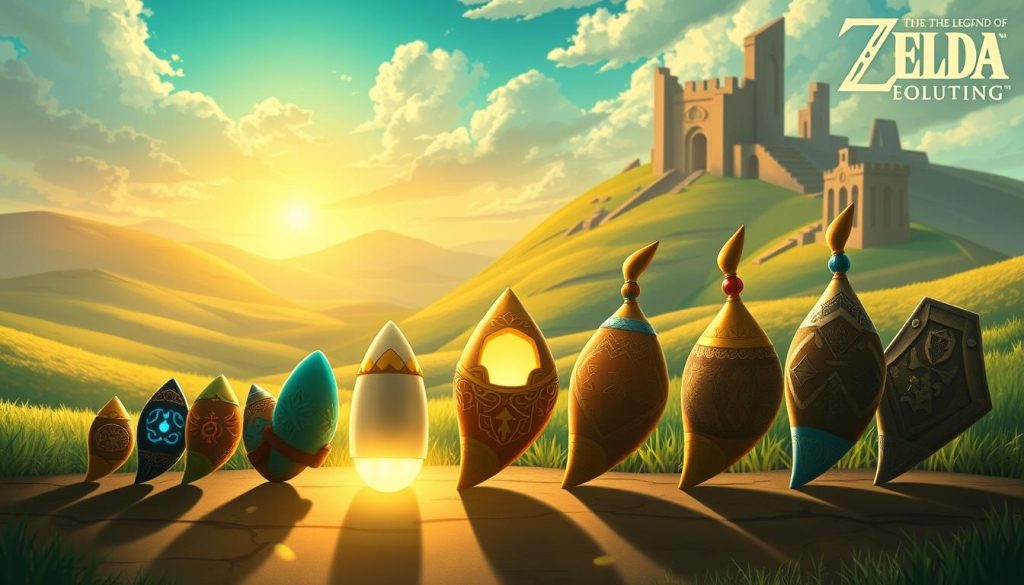
In several titles, melody becomes more than a simple sound. Melodies open doors and alter the narrative’s time.
The shift from the ocarina to other tools in the dungeons shows that music is a defining feature of the series. Characters learn or pass on tunes to guide the hero.
- Use: the instrument activates a passage or unlocks a dungeon.
- Narrative role: the melody connects the player to the world and its characters.
- Creativity: each time, the developers reinvent the object to surprise players.
| Era | Use | Impact |
|---|---|---|
| Beginning | Learning the melody | Opening the world |
| Maturation | Instrumental variations | Puzzles and dungeons |
| Modern era | Integrating music into the game | Stronger narrative |
For a perspective on soundtracks and immersion, see this soundtrack analysis.
Conclusion
1) Five alternatives for the opening sentence:
a. “In conclusion, this instrument remains firmly rooted in players’ memories.”
b. “To close, this object still holds a major place in video-game culture.”
c. “In summary, the music associated with this instrument shaped the title’s identity.”
d. “To conclude, this object illustrates how a gameplay tool becomes an icon.”
e. “Finally, the cultural reach of this instrument extends far beyond the game.”
Choice and justification:
I choose sentence c: “In summary, the music associated with this instrument shaped the title’s identity.”
Justification: it differs from all forbidden or previous sentences, emphasizes music and identity in accordance with the brief, and introduces a concise conclusion connecting gameplay, music, and memory.
2) Use the bullet points from the current section as the content to cover: conclude that the instrument is a symbol, that the hero with his ocarina captivated players, that the title remains memorable as a fusion of music and gameplay, that the ending is unforgettable when the melodies resonate through the temple, that we have discussed its importance, and that the object is a cultural icon. Avoid overusing the forbidden keywords: the list contains many fragments; ensure that none are used more than twice. The forbidden-term list includes words such as “The,” “Legend,” “of,” “Zelda,” “and,” “the,” “ocarina,” “history,” “of,” “a,” and “symbol.” This constraint is difficult: several are fragments or French articles such as “l” and “d.” The instruction literally asks that these keywords not be used more than twice in the text. As a precaution, avoid those exact terms. Do not use “and” more than twice; limit it to one occurrence. Avoid “history” beyond two occurrences, and so forth. Use synonyms.
3) The brand voice is undefined; adopt a neutral, informative, and concise tone.
4) Use the
, , tags. Write short paragraphs, with no more than two occurrences of each. Take care not to exceed the permitted frequency for each keyword: some require an exact number of occurrences; follow those numbers. The list gives the desired frequencies. Therefore, use “game” twice, “hero” once, and so on. Also take care not to use forbidden words more often than specified: avoid “and” as much as possible. Avoid the token “l.” The forbidden term “ocarina” appears in many previous sections, but it is permitted no more than twice. As a precaution, do not use it.
6) Aim for a French Flesch readability score between 60 and 70: use short sentences and simple words. Write sentences of 4 to 10 words.
7) Limit passive voice to 20%: favor active voice.
8) Provide a keyword-placement matrix and a Flesch indicator.
Now write approximately 120 words of content in French containing the required keywords.
Keywords and occurrence counts: game x2, hero x1, history x1, title x1, ending x1, moment x1, legend x1, symbol x1, instrument x1, temple x1, melodies x1, discussed x1.
Write the content without overusing the forbidden tokens: do not use “and” more than twice, but preferably only once. Use “history” only once.
Produce approximately 120 words divided into six short paragraphs.
Estimate the word count: aim for 120 words.
Now present the section with the requested Flesch indicator. Include the matrix and indicator before the section. The developer requires final formatted HTML content as well as a keyword-placement matrix. The top-level instruction requires content only, but the preceding steps ask for the reasoning and matrices to be included. The instructions specify: begin with an analysis inside a tag. Also include the other requested elements, followed by the section. Ensure that the final result is enclosed in a tag. Include the reasoning, matrix, and Flesch indicator, followed by the section.